Sunday, February 6, 2011





By Marty Basch
Cross-country skiers can travel from inn-to-inn in search of creature comforts and warmth.
Backcountry skiers traverse the high country and woods searching for steeps, chutes and playful, challenging lines.
Then there is, to coin a phrase, bogcountry skiing, an easy-going free-heeling jaunt into the white expanse of the frozen wetlands ferreting about for flora and fauna or at least the tracks they leave behind.
Bogcountry skiing begins with a bog, those acidic peat quagmires loaded with moss and dead plant material.
Western Maine's Brownfield Bog, on the New Hampshire border, is a shining example with some 5700 acres teeming in the non-snow months with migratory waterfowl, deer, moose, warblers and more wildlife.
In winter, mammal- and bird-spotting is less active but with the keen eyes of Albany-based Tin Mountain Conservation Center staffers and fellow nature-loving skiers it's possible to see the tracks of a snowshoe hare or a woodpecker high in a tree along with other glimpses into nature some best experienced with binoculars.
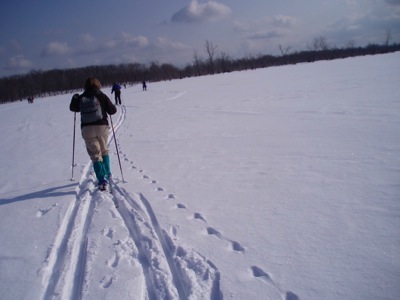
Tin Mountain's annual cross-country ski trip into the bog is a popular outing and some 25 people enjoyed schussing for a few hours recently on a relatively flat volunteer snowmobile-dragged groomed trail into the forest before venturing out on the frozen desert-like landscape that in spring, summer and fall abounds with paddling opportunities in its ox-bow network.
As with any group trip with a curious bunch, bogcountry skiing can get a bit bogged down with a lot of stop and go as skiers of various abilities debate what left those tracks in the snow. Was it a bounder, a leaper, possibly a perfect walker? Prints, tracks, strides and leaping ability are all clues to what type of creature passed through and snow sleuths like to play trailside detectives.
"We saw a lot of fox tracks, a lot of coyote tracks, ermine, some fisher tracks, possibly otter, snowshoe hare at the very end, a lot of small rodents and some squirrel," said education director Lori Jean Kinsey.
Armed with small tracking books and cards that helped them measure the tracks and identify them, skiers could take note of the habitat, size of the animal, and how they move to try and figure it out.
"Those are all clues," said Kinsey.
But not all sightings were in the snow. The odd sack-style nest of an oriole hung from one tree while pileated woodpeckers left behind their pockmarked dead tree excavations.
The most awe-inspiring sight came during the bag lunch break on the bog's banks when a skier with binoculars announced he was looking at a pair of bald eagles. They were easily spotted from afar with the glasses.
Bogcountry skiing is loaded with learning. Skiers traveled by the brown and curled leaves still hanging from American beech, white oak and witch hazel. These stragglers are marcescent leaves that fall from strong winds or when buds push them off in spring. The leaves don't form an abscission layer, a natural detachment of parts of a plant.
Though moose weren't seen, they were definitely in the neighborhood leaving behind scrapings on trees called moose barking.
"Moose will primarily go after red maple, occasionally birch and sugar maple," said executive director Michael Kline. "They have incisors only on the bottom of their jaw so they scrape and take these strips off. You can see the teeth marks. A lot of people think it must be a bear or a buck rub. Moose eat a lot of bark in the winter. You can see where they walk."
Brownfield Bog is something of a four-season classroom and playground for nature and outdoor lovers. Kayakers paddle, snowshoers hike, bird-watchers scour the sky and hunters target waterfowl and more.
"Any wetland has a lot of available water all the time," said Kline. "It is so different in the winter because it is essentially a biological desert in the winter. The water is frozen up so it is interesting to look at these plants. I love to see these plants up close because it is hard when you are in a kayak floating around. Here you can just ski up to the wetland plants and shrubs and look at them close."
From perched bald eagles to coyote tracks in the snow, one never knows what's out there while skiing Brownfield's bogcountry.
.